|
Handmade Paper / Pulp Painting
In working with landscape, what interests me is the challenge of re-creating and synthesizing my experience of the atmosphere of a particular place and time. The use of paper as an integral part of the artwork instead of just the recipient surface, continues to be a source of inspiration for my work.
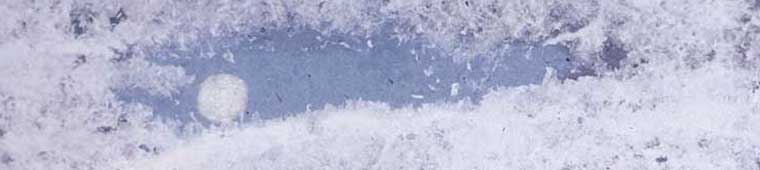
The work you are looking at is not painted onto the paper. The colors, the forms and textures are created by applying pigmented pulps (made from cellulose, specifically cotton and abaca) onto the surface of a freshly made sheet of paper. Since pulp is a fiber, one cannot apply the color with a brush. I use a thin 'couched' (laid down) layers of pulp build up detail using applicator bottles, pouring, stenciling, glazing and rubbing techniques, working wet on wet, to create the image. This technique is also known as 'pulp painting.' When the composition is complete, the sheet is pressed and dried. Occasionally I will add some pastel or colored pencil markings to highlight or accent some area of the work. The larger sheets of paper are created by spraying pigmented pulp through a hopper and a compressor gun onto a large canvas, clothing or object. The pulp will conform to the shape that it is sprayed on. Once the pulp has dried it can be peeled off of the recipient surface easily.
I was trained as a weaver and fiber artist. In the late sixties I studied with Gretchen Mueller at 'The Weaver's Trade' in Cambridge, MA and with Ted Hallman at the Penland School of Crafts in North Carolina. My tapestries often took several months to complete and I found that I became quite attached to and reluctant to sell them. In an effort to make my artwork more commercially viable, I tried printmaking, specifically monoprints, but missed the tactile and color intensities of fibers.
In 1981 I took a papermaking workshop at Bennington College with Joe Zina, Co-founder with Bernie Toale of Rugg Road Papers. I remember walking into class the first morning getting directions, dipping my hands into a vat of pulp, and experiencing the thrill of making my first sheet of paper. Once pulp painting techniques were introduced, I was hooked. I knew this was what I wanted to do, this was my medium. Papermaking for me combines the most interesting qualities of weaving, printmaking and painting. I asked classmates to bring food from the cafeteria for me because I didn't want to miss any studio time.
Fabric Collage
I have recently become entranced by the possibilities of fabric
collage. I was introduced to fabric collage by Clara Wainwright (Clara
Wainwright.com) through my participation in Clara's Faith Quilt
Project. Fabric collage consists of using the innate qualities of
fabric, the images, colors, textures and patterns to create another
image. Essentially the technique is painting with fabric. The fabric is
cut and glued to a sub surface such as cotton, canvas or board. The
image can then be top stitched, embroidered or painted on as needed. I
see this new medium as a natural evolution of my work as a fiber
artist, from weaving to papermaking and now fabric collage. I am still
working with the same basic material, fiber. For me, the limitations of
papermaking and pulp painting are the inability to create detailed
images as well as the difficulty of using bright, saturated colors in my
landscapes.
Fabric collage frees me to include complex images and bright colors as
well as begin to explore spiritual and philosophical ideas that are
impossible in pulp papermaking. I can explore greater narrative expression
in fiber collage, and it is great fun! The economy of materials is also
appealing. I can work anywhere, all I need is fabric, scissors and
glue. Papermaking requires, pulp, equipment and heavy lifting. My work continues to evolve from yarn fiber to fabric fiber, all fiber, but what a different world I can create with each medium.
Please contact me for more information.
|

|